Loading
German Standard Group needed one platform for its education division: live lectures, on-demand video courses, in-person workshops with certificates, and a professional community for vets across the MENA region. Novamind designed and built all of it: a React Native app for iOS and Android, the website at gsgacademy.co, a staff admin panel and the NestJS API behind them. Work began in early February 2026, version 1.0 reached the App Store on April 22, 2026, within three months of the start, and store releases have continued since.
An academy that teaches in person and online, in several countries, with a partner that co-signs its certificates.
GSG Academy is the education division of German Standard Group, a veterinary supplier that has operated across the MENA region since 2009. The group is headquartered in Dubai, works across seven countries and lists four divisions: Medicines, Supplements, Equipment and GSG Academy.
The academy is KHDA-approved, per gsgacademy.co, which names the Knowledge and Human Development Authority as its UAE accreditor. Its courses are co-delivered with Improve International, whose Arabia site lists GSG Academy as its training facility in Dubai, with a wet lab for hands-on sessions; Improve International Group was founded in 1998 and its qualifications are awarded by ISVPS. In the academy's own words, certificates of completion “are issued only for in-person courses at our branches, co-signed by Improve International and recognised across MENA”.
The brief was one system that could sell and run every format the academy teaches. Live lectures with chat, questions and a replay. On-demand video courses with progress tracking. In-person workshops, wet labs and conferences with seat booking and meal selection. Certificates for in-person attendance, credentials a vet can upload for verification, and a community feed and messaging so the learning does not stop when the session ends. All of it tied to one profile per vet, on iOS, Android and the web, with role-aware content for vets, students, nurses, receptionists, lecturers, recruiters and staff.
The academy's public branches are Dubai, Riyadh, Doha and Egypt, with Oman listed as opening soon, so attendance had to be scannable by staff at any venue and the same app had to serve vets in each of those markets. That mix of formats, venues and partners is the kind of requirement we wrote about in custom software versus off-the-shelf.
“The app, this website and the platform behind them were designed and built by Novamind Technologies, a UAE software house.”
Read the About pageFour parts that share one data model: the app people download, the website search engines index, the panel the academy team runs the business from, and the API underneath all three.
One React Native codebase for iOS 15.1 and later and Android 7.0 and later, published under German Standard Group's own developer accounts. Courses, live streams, the community feed, direct and group messaging, VetHub events, programs, wallet, certificates, points and ranks, all in one download. Google Cast for video, add to calendar on enrollment, push notifications, offline caching and pull to refresh are built in, and over-the-air JavaScript updates mean many fixes reach phones without waiting for a store review. The current store version is 2.5.
A public site with a page for every course, program and VetHub event, each carrying structured data, plus a dynamic sitemap for search engines to follow. Around the catalog sit the pieces an app needs on the web: the share funnel, a stream landing page, a check-in verification page, a password reset fallback and an account deletion flow. Universal links and Android App Links are configured for gsgacademy.co and gsgroup.co, so a course URL opens the native app when it is installed. When we checked on September 4, 2026 the sitemap listed 74 URLs: 57 course pages, 3 program pages, 1 VetHub event page and the site's own pages.
The panel the academy team works from: users, courses and reviews, programs with sections and cohort runs, VetHub events with runs and a per-event QR scanner, streams with pause and resume, recordings and subtitles, a unified QR check-in scanner with manual check-in and undo, a certificate verification queue, post moderation, flagged messages, groups, coupons, finance with orders, refunds, disputes and plans, email templates and campaigns, analytics, ranks, locations, specialties, and settings with audit logs. Every screen is gated by permissions.
A NestJS back end on PostgreSQL with Prisma, Redis with BullMQ for background work, Socket.IO for chat and live features, card payments, Firebase Cloud Messaging for push and Sentry for error reporting. Workers handle video transcoding, certificate OCR, image resizing, notifications, email campaigns and rank calculation, so the request path stays fast. The same API serves the over-the-air update bundles to the app.
The parts of the platform that carry the academy's day to day: selling seats, proving attendance, running a live room and getting a link into the right hands.
On-demand video courses with lesson progress tracking, in the specialties the App Store listing names: surgery, internal medicine, cardiology and emergency care. Course videos get auto-generated subtitles and transcripts. A course is either online or physical; physical courses carry a venue, seats, meal selection and QR check-in. Certificates of completion, in the academy's words, “are issued only for in-person courses at our branches, co-signed by Improve International and recognised across MENA”, and a vet can upload existing credentials for the academy team to verify.
Every in-person seat comes with a QR code. Staff scan it at the door with the admin panel's unified scanner, which also allows manual check-in and undo, and the attendance lands on the vet's profile. The website puts it plainly: “Scan once at the venue and your attendance is logged in your profile automatically.” A matching check-in verification page lives on gsgacademy.co.
Live lectures play over HLS with live chat, questions and answers, pause and resume breaks, and a replay of the recording. Watching a stream earns points toward a vet's rank. The academy team creates, pauses and resumes sessions from the admin panel, with recordings and subtitles managed in the same place, and a stream landing page on the website carries the link into the app.
Larger gatherings run as VetHub events with scheduled runs, a QR pass per attendee and per-event check-in from the admin panel, so a conference uses the same scan-to-attend flow as a single course. Each event has its own page on gsgacademy.co and can be shared from the app.
Multi-section curricula with cohort runs, section passes and registration codes, so the academy can sell a structured program rather than a series of unrelated courses. Each program has its own indexable page on the website, and the admin panel manages its sections and runs.
Posts, streams and VetHub events can be shared from the app as gsgacademy.co/share links with a preview sheet. On a phone with the app installed the link opens the app directly through universal links and Android App Links; on any other device it lands on the website, which carries an open-in-app banner and the store links.
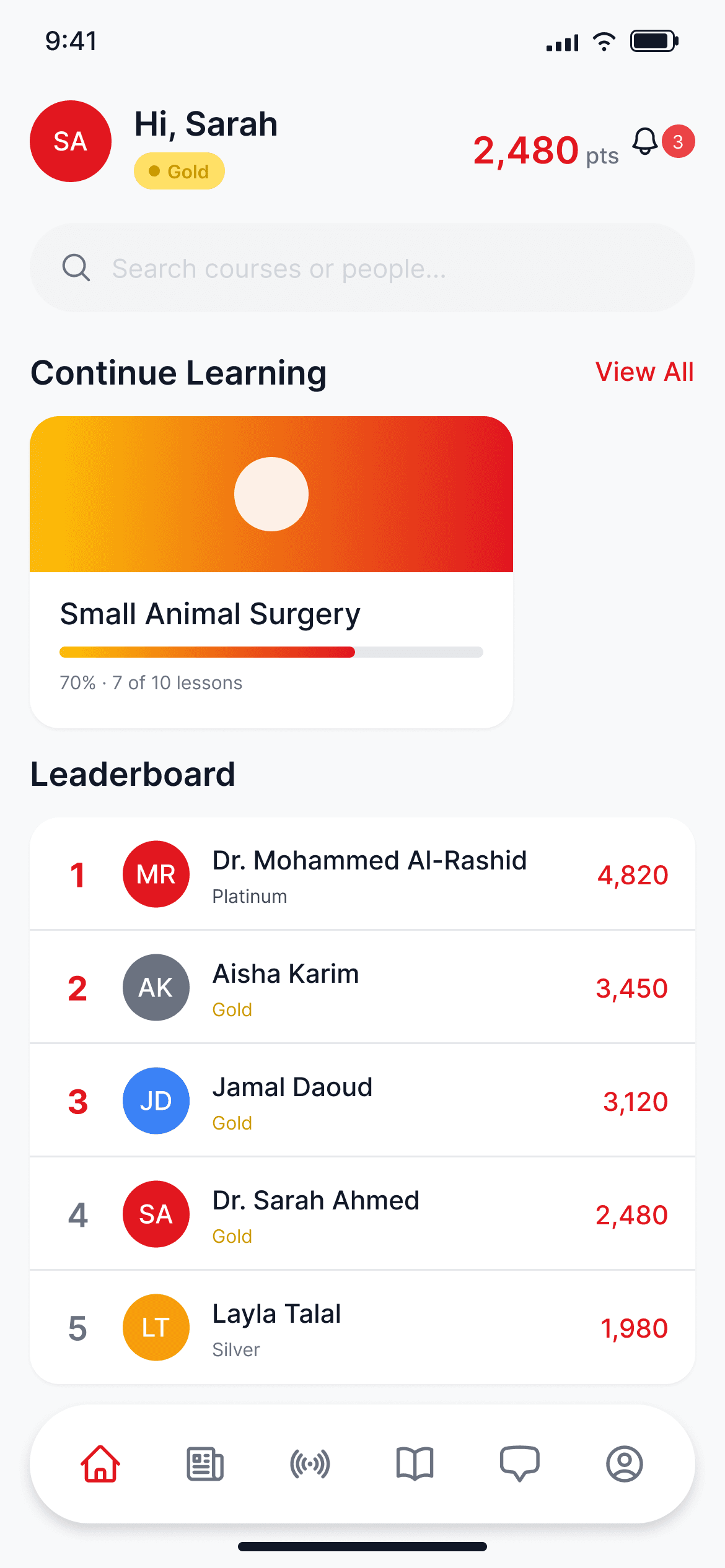
The app also carries a community case-share feed, direct and group messaging, a points and rank system (Bronze, Silver, Gold and Platinum), saved locations, a wallet and bookmarks. The full feature list is on the App Store and Google Play listings.
The same four phases as every Novamind project, plus the releases that have followed since launch.
Written scope
We mapped what the academy teaches (live, on demand and in person), who uses it (vets, students, nurses, receptionists, lecturers, recruiters and staff) and what had to be true on day one: payments, attendance, certificates and a profile that carries all three. The output was a written scope, the same first step as every Novamind project.
Screens and API contract
Screens for every primary flow in the app and the admin panel, and an API contract so the mobile and back-end work could proceed in parallel. Role-aware content, QR attendance and the share funnel were designed in from the start rather than added later.
Staged builds
Back-end and mobile work started in early February 2026, with the repositories created on February 3, and substantive admin panel work followed in April. The API, the app and the panel were built against one shared contract, with a staging environment updated as features landed.
Store listings and production
Version 1.0 reached the App Store on April 22, 2026, 78 days after the first commit and within three months of the start, with the Android app following on Google Play. Store submission, signing certificates, push notification setup and deep link routing were part of the delivery, and the listings sit under German Standard Group's own accounts, so the client owns the listings as well as the code.
Versions 2.4 and 2.5
Programs, the website and the SEO catalog followed in May and June 2026, over-the-air updates in June, and store releases 2.4 and 2.5 in August. Novamind's terms are the same on every project: fixed scope, code the client owns outright, and a 30-day warranty after launch. The details are on the services page.
Public milestones from the first commit to the latest store release, taken from the project repositories and the store listings.
Every public claim on this page was checked on September 4, 2026 against the pages below. Build dates and stack details come from the project repositories, which belong to the client.
The same four parts serve academies, professional bodies and training institutes: an app people download, a website that search engines index, a panel your team runs the business from, and an API you own. Tell us what you teach and to whom.